

The first steps to be taken when a death occurs are often the hardest for people to make.
At D.J. Bewley, the family funeral service we have experienced local staff on call at all times:
There are key things you must do in the first few days after someone dies. Our advice is always to contact your funeral director first.
Unless present when death occurs, the relatives will be notified by the nursing staff as soon as possible. Sometimes relatives or friends ask to see the deceased in the mortuary chapel. This can usually be arranged directly with the hospital. Arrangements can then be made with the Hospital Patient Affairs office staff to deal with the formalities.
These will include collecting the medical certificate of cause of death (issued by a Hospital Doctor) and personal possessions of the deceased. The hospital may also issue a ‘Release Form’, which needs to be signed by the next of kin, releasing the deceased into our care. When you are ready you can call us to make the arrangements and collect your loved one from the hospital.
Our Local hospitals are:
Swindon Great Western Hospital Bereavement Office
Opening Times: Monday-Friday 10.00am-4.00pm
Contact Tel: 01793 604392 or 01793 604393
Bath Royal United Hospital Bereavement Office
Opening Times: Monday – Friday 8:30am – 4:00pm
Contact Tel: 01225 824015 or 01225 824315
Salisbury Hospital Bereavement Office
Opening Times: Monday – Thurs 9:30am – 4pm and Friday 9:30am – 3:30pm
Contact Tel: 01722 425150 or 01722 425283
Bristol Royal Infirmary (BRI) Bereavement Office
Opening Times: Monday – Friday 8am – 4pm
Contact Tel: 0117 342 9048 or 0117 342 9049
If the death was expected, as the deceased had been ill for some time, it would be normal to contact their doctor or the out of hours doctor who would then visit to certify that death had occurred and determine the cause of death.
This may not happen immediately as the doctor may be in his/her surgery or the death may happen in the middle of the night. The doctor will issue the relatives a form called the medical certificate of cause of death. This form contains a list of who can register the death. This form should be available at the surgery within 24 hours of the death.
Once a doctor has attended, please contact us and we will be able to provide guidance and support and will, if so desired, attend to remove the deceased to our private chapel of rest. We offer a 24-hour service.
Repatriation is the process of returning a person to their place of origin or citizenship. This includes the process of returning a person back home to England or transferring someone from England back to their home country.
We at D.J. Bewley are on hand to help families, friends and communities repatriate their loved ones to and from abroad, to ensure your loved one’s safe return home:
We can advise on documentation required and coffin and casket requirements.
We will deal with UK authorities, embassies, consulate visits, freight booking services and delivery and collection.
We understand what a difficult and confusing time it is when a friend or relative dies while traveling, living or working abroad.
There are several reasons why a death might have to be referred to the coroner, for example a sudden or unexpected death, a death following a road traffic collision (RTC), suicide or when a doctor has not seen the deceased in the last 2 weeks. In these cases, a post-mortem examination may be required. During the post mortem examination a person with either medical or legal qualifications can be present to represent the interests of the family.
Such representation will be at the expense of the family.
After a coroner’s post mortem you will be informed by the coroner’s officer when they have sent their paperwork to the Registration Office so that you can make an appointment to register the death. A post mortem examination does not usually delay the funeral. The coroner’s officer will keep you fully informed.
We can arrange for the person who has died to be taken into our care at one of our chapels of rest and are on hand to provide support and help throughout this difficult time.
When a death has occurred and you make the initial call to us:
We will also arrange a suitable time to meet with you, either at one of our funeral homes. Alternatively, we can arrange for our funeral director to visit your home or, if you prefer, somewhere else such as a friend’s house or a solicitor’s office.
When you meet the funeral director, they will be able to advise you on what to do next, take care of all the necessary funeral arrangements and explain, in detail, the procedure for registering the death.
When the death takes place some distance away from home, either within the UK or abroad, we can make all the necessary arrangements. Our Funeral Directors will provide help and advice and can assist with arranging repatriation to and from anywhere in the world.
We are contactable at any time of the day or night, every day of the year, when our experienced staff will be on-hand to support and assist you.
When someone dies, registering the death is the formal, legally required process by which you can obtain a death certificate.
This document is essential: banks, insurers, pension providers, government agencies, and funeral directors will typically require a certified copy before releasing funds, settling estates, closing accounts or granting permissions (e.g. burial or cremation).
Without a death certificate, it can be extremely difficult to carry out many of the legal, financial and administrative tasks that follow a death.
Before registration, the death must be medically certified. The process is as follows:
The law allows certain people to carry out this task:
Once the medical certificate is ready, it is time to schedule an appointment at your local register office to register the death. In most cases the registrar will telephone the family to invite them to come in.
To register the death you must present certain documents and details. You will need:
It’s wise to check ahead with the register office to confirm exactly what is required.
When you meet with the Registrar he or she will:
Naturally a sudden death together with the Coroner’s involvement can be very distressing. You may have a number of questions.
We are fully acquainted with all procedures and we are here to help and guide you.
A Doctor May Report the Death to A Coroner If The:
A coroner must hold an inquest if the cause of death is still unknown or if the person:
You can’t register the death until after the inquest. The coroner is responsible for sending the relevant paperwork to the registrar and can give you an interim death certificate to prove the person is dead. You can use this to let organisations know of the death and apply for probate. When the inquest is over the coroner will tell the registrar what to put in the register.
Our telephone number is answered 24 hours a day. From your first call, we will be able to discuss the initial steps with you and arrange to meet with you. We usually go out to family addresses in the comfort of your own home, to make the funeral arrangements, but if you would prefer to come into one of our offices please telephone first.
We aim to make it as easy for you as possible at this time. We will offer you advice on registration, and even make the appointment for you, if you wish. You do not need to have registered the death to begin making the arrangements although there is usually a “green” form we need from the registrars, so if you register first you will have all the paperwork we need.
To arrange the funeral, we do need to complete some paperwork. First and foremost, we like to begin the arrangement with a “blank page”. We like to get to know you, and your deceased loved one and we think a funeral needs to be a reflection of their life.
If money is an issue, we may be able to help you organise a very simple funeral. Please see our help and advice for financial assistance.
We will then talk through together the specifics of the funeral. Our aim is to help you find your own personal way to say goodbye. You may already have quite a clear idea of how you wish the funeral to be, but if not; we will present all the options available to you so that you may be aware of all your choices which will enable you to make the right decision for you and your family. Please see our Planning the Funeral Service within our Help and Advice for an outline of the things we will need to know.
Generally, we will be able to arrange the day and time of the funeral while you are with us so as soon as you leave you can start letting friends and family know. From here on, we are able to take all the burden from your shoulders as we take care of all the administration and the practical elements of the funeral, so that you may concentrate on taking care of yourself and being with those who are supporting you.
Once the arrangements are made, we provide you with an estimate of costs. The estimate consists of all the arrangements and how much our services are likely to cost. Included in this will be an estimate of third-party costs (known as “disbursements”) which are standard charges incurred by every Funeral Director. Within a few days you will receive a confirmation letter outlining all of the arrangements we have discussed.
We stay in touch over the next few days and continue to build upon the foundations laid in our initial meeting, until we have finalised all the details and have created the send-off your loved one would have wanted.
The decision of whether to visit the deceased is obviously yours and yours alone. There is no right or wrong answer as to whether you should or shouldn’t visit.
This is one aspect of the funeral where we can’t really advise you. But, over the years, we’ve found that many people take genuine comfort from seeing the deceased at rest and having some final time together.
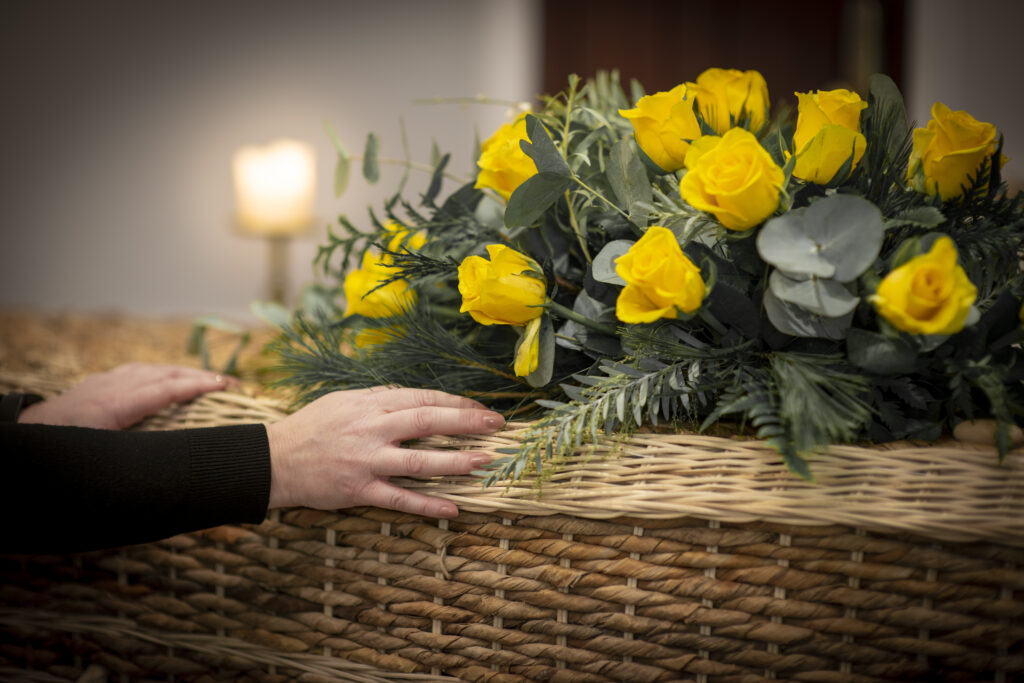
Everyone is unique, so there will be no pressure from us to visit – this is your decision and we have a private remembrance rooms (sometimes called ”Chapel of Rest”) available in our office locations or you can have your loved one at home, if you prefer. We’re always happy to fit in with your arrangements.
If you choose to use our chapel of rest, why not display a photograph or a small selection of things that reflect the life of your loved one? This is just another way that you can help personalise your funeral with us.
Our private Chapels of Rest are open every day
Monday – Friday: 9.00am – 4.30pm
Saturday: 9.00am – 12.00 noon
Please call to make chapel of rest viewings inside or outside of these times. It is important to contact the person arranging the funeral as there may be restrictions on viewing arrangements.
When looking at the best way to let friends and family know, there are two aspects to bear in mind:
The thought of passing on the news of a death may be daunting and overwhelming, even more so where there are a lot of people to tell fairly quickly.
People who you are unable to contact can be informed via a death notice in the local newspaper which we are able to help you compile once the funeral date and location has been agreed.
We can also create a memorial online page where people can leave messages and donations in memory of the loved one.
We will be there to guide, help and support you through the day. We will ensure that the funeral proceeds on time and carry out all your instructions that have been previously arranged.
Having made all the necessary arrangements, there should not be too much for you to think or worry about on the day of the funeral itself, although close relatives can feel a little anxious as the time approaches.
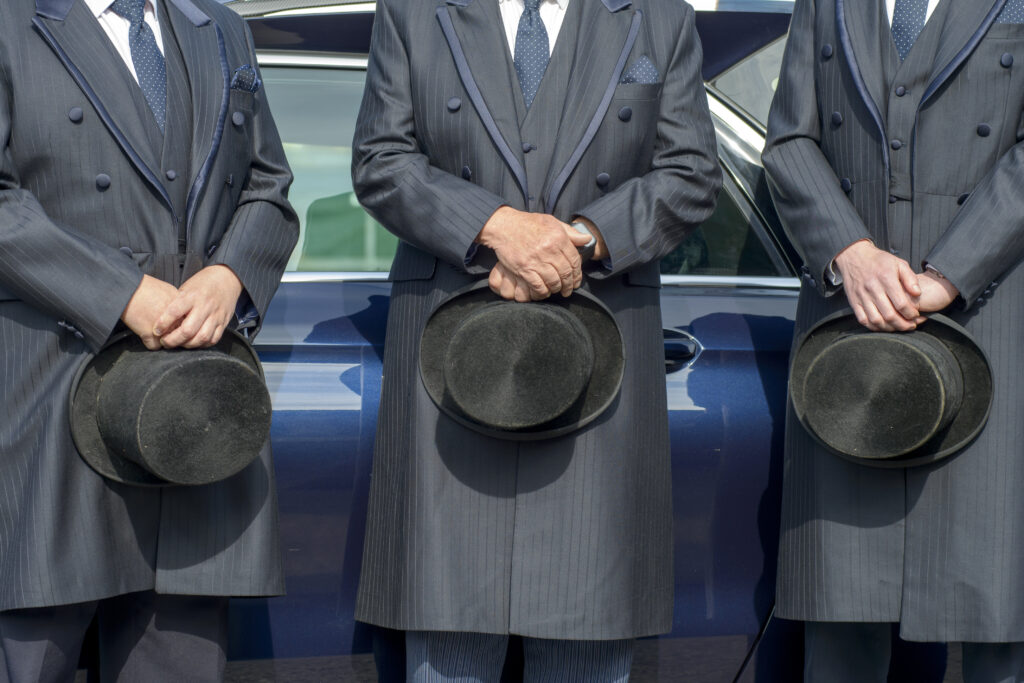
If we are travelling direct to the church or crematorium you will be greeted by the funeral director there. You may wish to allow plenty of time to see us arrive with the hearse.
If we are meeting before the Church, Chapel or Crematorium, the cortege will arrive at the agreed address at the time given to you on your confirmation letter (please allow us a couple of minutes either side of this time for variations in the volume of traffic).
We will then escort you and your family to the limousine(s) if any have been ordered. Once everyone is seated, the funeral director will lead the cortege away from the house and travel to the place of service.
If the service prior to cremation takes place in a church, on arrival, the funeral director will first go and speak with the minister, then come and collect you when everything is ready.
The funeral director will now ask whether you would like to follow the coffin or if you would prefer to be seated first. If you wish to be seated first the funeral director will guide you to your seats.
If you wish to follow, the coffin will be taken in to the church and you will be asked to follow behind. Once inside the funeral director will guide you to your seats. At the end of the service, the coffin will be taken out of church and placed on to the hearse to go to the Crematorium or Cemetery. You will be asked to lead the mourners out of church, behind the coffin.
At the crematorium, the coffin is taken in to the chapel, and placed on the catafalque. Again, you will be invited to follow behind the coffin, and the funeral director will show you to your seats. After the service, the funeral director will lead you to the courtyard to look at the flowers and to thank mourners for attending.
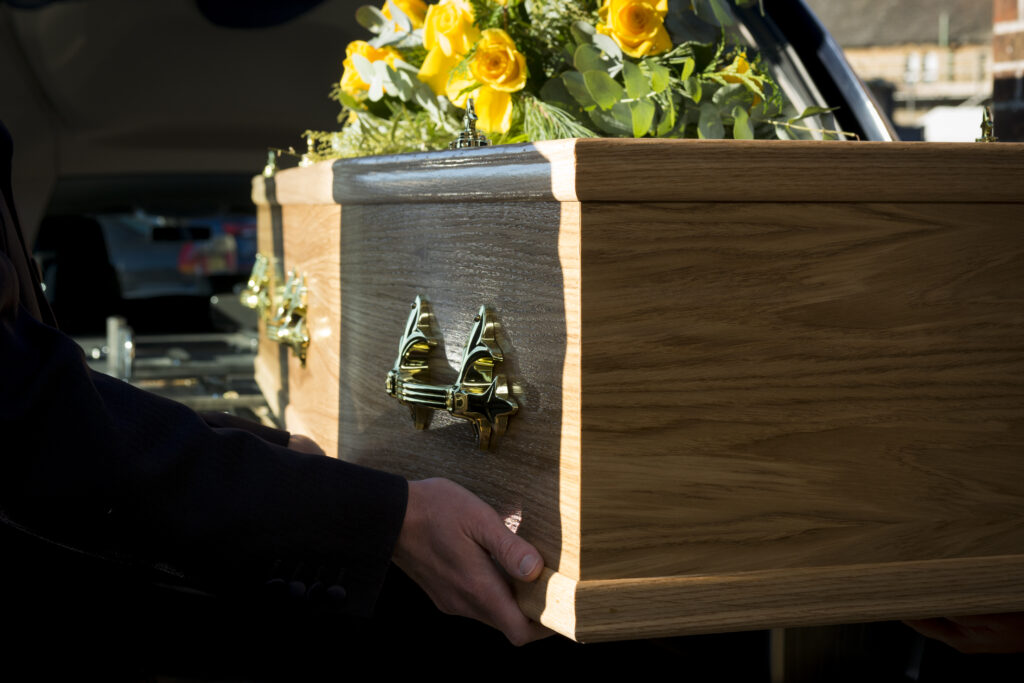
The main family flowers are usually placed on top of the coffin and will stay there until the chapel is empty at which point the funeral director will collect them and bring them out. If you wish your flowers to stay with the coffin for the cremation please inform us.
Following the committal service at the crematorium, the limousine(s) if ordered will take you back to an address of your choice, or to a reception venue. Please advise us of the return destination prior to the day of the funeral to ensure our chauffeurs can be instructed accordingly.
If the service proceeds to a cemetery or Churchyard for burial, the funeral director will lead the way to the grave and you will be asked to follow behind the coffin. You may gather around the grave, whilst the committal takes place, you will be invited to scatter earth/holy water into the grave if appropriate. Some people also choose to bring single stemmed flowers for the same purpose.
The funeral director will then lead you to look at the flowers, which will be laid out along the ground. Once you have left the cemetery, the flowers will be placed on to the grave once backfilled and tidied which usually takes 1-2 hours . If you wish your floral tribute to remain on the coffin whilst it is lowered, then please tell us in advance.
Following the committal service at the cemetery, the limousine(s) if ordered will take you back to an address of your choice, or to a reception venue. Please advise us of the return destination prior to the day of the funeral to ensure our chauffeurs can be instructed accordingly.
Every funeral is different but we hope this gives you some idea as to what to expect on the day. Your funeral director is there to assist and to make sure everything runs smoothly, if you have any questions or concerns then please just ask.
